
Cross-project collaboration is a structural principle of CORE. The research unit brings together eight complementary projects across three research areas, combining different disciplinary perspectives, methodological approaches, and empirical data.
CORE has established structures that enable researchers to work continuously across project boundaries. Principal Investigators, international Co-PIs, postdocs, doctoral researchers, and other CORE members contribute to cross-project task groups, joint research activities, and shared scientific infrastructures.
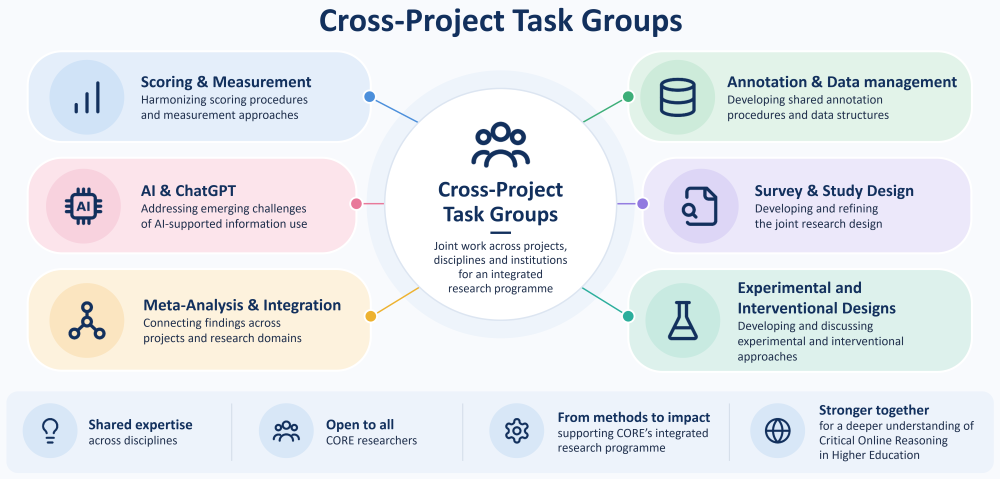
These working structures address research questions and methodological challenges that extend beyond the scope of individual projects – from the development of the joint study and assessment design to scoring and annotation procedures, the analysis of emerging AI-related challenges, and the integration of findings across projects.
The CORE’ aim is not simply to coordinate individual research activities, but to create scientific added value through systematic integration. Through task groups, shared research infrastructure, Round Tables, colloquia, joint publications, and international scientific exchange, CORE creates sustained opportunities to connect concepts, methods, data, and findings across projects.
This integration enables CORE to move beyond individual project findings and develop a coherent, interdisciplinary account of Critical Online Reasoning in Higher Education.
How CORE creates added value through collaboration
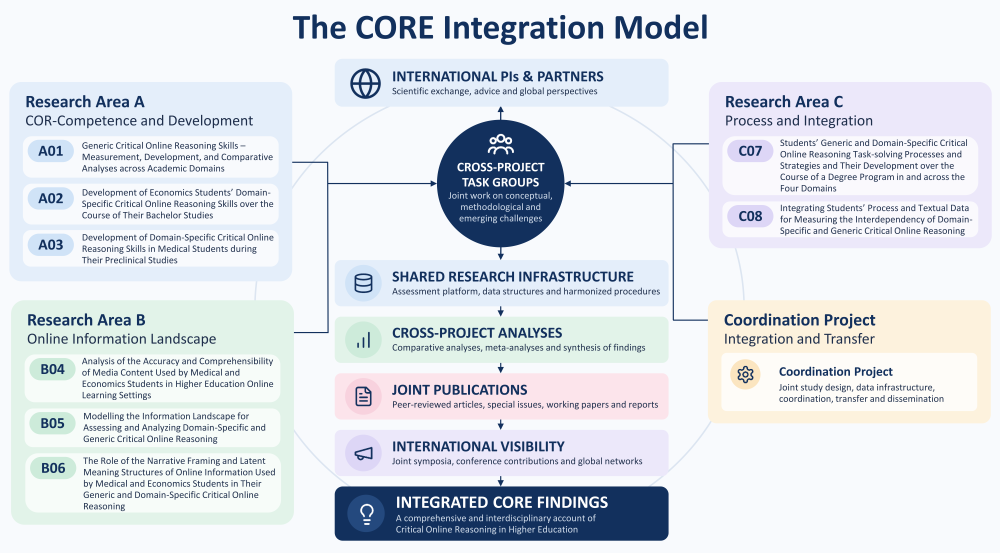
An integrated account of Critical Online Reasoning in Higher Education
Cross-Project Task Groups
Cross-project task groups provide a dedicated structure for sustained scientific collaboration. They bring together researchers across projects to address challenges that require shared expertise and cannot be fully addressed within a single project.
The task groups are open to researchers across CORE, and YOREs are actively involved, including in leadership and coordination roles. This structure enables CORE to continuously align conceptual approaches, methodological procedures, and data-related practices across projects.
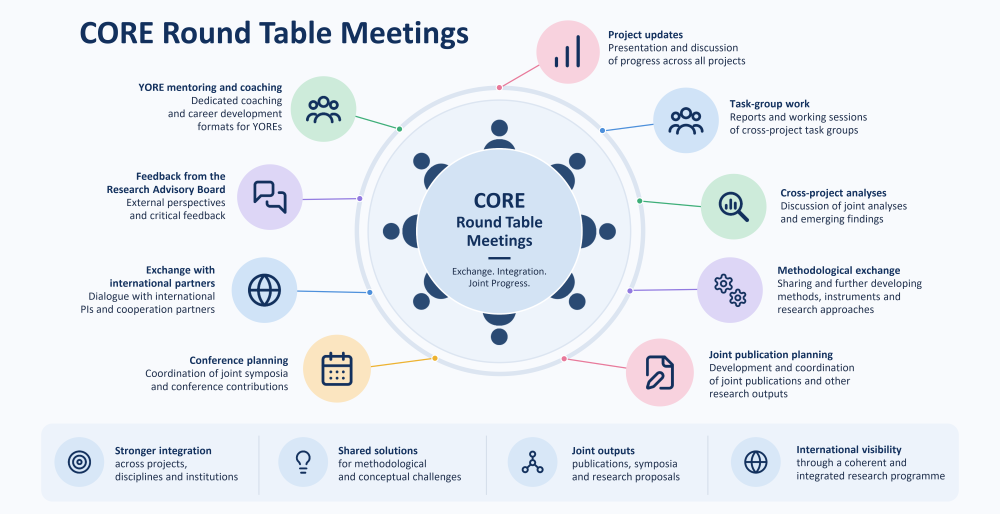
Round Table Meetings – A regular forum for scientific integration
The biannual CORE Round Table Meetings are a central mechanism for cross-project collaboration. Held once each semester, they bring together researchers from all eight projects as well as international Co-PIs and cooperation partners.
The meetings combine scientific reporting, methodological exchange, cross-project analyses, collaborative planning, and strategic discussion, and include data analysis workshops, exchanges with international Co-PIs and cooperation partners, and targeted coaching and scientific exchange for YOREs.
The Round Tables therefore serve not only as meetings for information exchange, but as a recurring infrastructure for integrating the scientific work within CORE. The international Research Advisory Board and cooperation partners provide critical feedback and contribute perspectives from the international research community.
Further Formats of Cross-Project Exchange
The Round Tables are complemented by additional formats that support continuous exchange and collaboration across CORE:
Research colloquia, held each semester, provide opportunities for CORE researchers and YOREs to present ongoing work and receive feedback from colleagues working on related questions from different disciplinary and methodological perspectives.
Lab rotations and research stays enable YOREs to become familiar with the research environments and methodological approaches of other CORE projects and international cooperation partners, and strengthen connections across projects.
Regular methodological workshops and retreats, and thematic meetings provide additional opportunities to develop shared approaches and address emerging challenges. Together, these formats create a multi-level collaboration structure ranging from informal scientific exchange to sustained joint research activities.
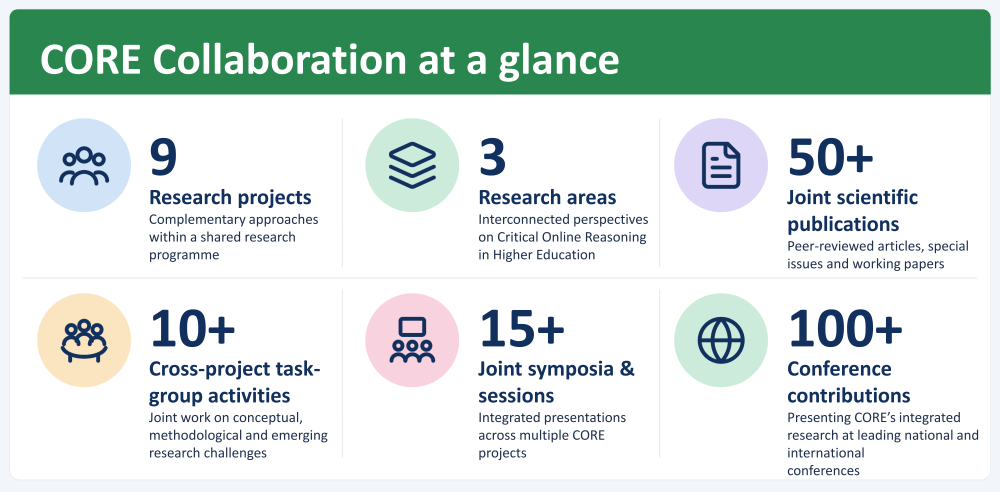
Turning collaboration into joint research outputs
Scientific output
The intensity of cross-project collaboration is reflected in CORE’s joint scientific outputs. Researchers across projects and institutions contribute to joint peer-reviewed publications, thematic special issues, working papers, technical reports, conference symposia, and cross-project presentations.
CORE has already established a visible publication profile around Critical Online Reasoning in Higher Education. Joint activities include thematic special issues in internationally recognized journals, including the Journal of Computer Assisted Learning, the Zeitschrift für Erziehungswissenschaft, and the Journal for Medical Education.
The CORE Working Paper series additionally documents the conceptual framework, methodological developments, study design, and research infrastructure of CORE.
Selected joint publications:
Drachsler, H., Zlatkin-Troitschanskaia, O., & Zottmann, J. (in press). Critical online reasoning in higher education: Reflecting on online information and AI tools in the digital age [Special issue]. Journal of Computer Assisted Learning.
Fischer, M. R., Kühlmeyer, K., Kuhn, J., Peters, H., Stadler, M., Weber, M., & Zottmann, J. M. (in press). Critical reasoning and argumentation for informed decisions in health care [Special Issue]. GMS Journal for Medical Education.
Zlatkin-Troitschanskaia, O., Hartig, J. & König, J. (2026). Critical Online Reasoning in der Hochschulbildung – Konzeptionelle und methodische Weiterentwicklungen und Perspektiven des internetbasierten Lernens. [Special issue: Critical online reasoning in higher education: Conceptual and methodological advances and perspectives in internet-based learning] Zeitschrift für Erziehungswissenschaft, I. https://doi.org/10.1007/s11618-026-01387-7
Cortina, S., & Zlatkin-Troitschanskaia, O. (2025). Kritisches Denken in der Hochschulbildung im digitalen Zeitalter. Zeitschrift für Pädagogik, 71(2), 141–144. https://doi.org/10.3262/ZP2502141
A complete list of CORE publications is available under Publications.
Presenting CORE’s integrated research internationally
CORE communicates its research internationally through joint symposia, coordinated sessions, paper and poster presentations, and contributions to major national and international conferences.
These activities bring together findings from nine CORE projects and make the FOR's integrated research program visible to the international scientific community.
Recent CORE activities include repeated joint contributions to AERA, EARLI, NCME, BERA/WERA, DGfE, GEBF, DGPs, and ITC, involving researchers from all CORE projects. These contributions demonstrate how complementary approaches and findings are connected across CORE.
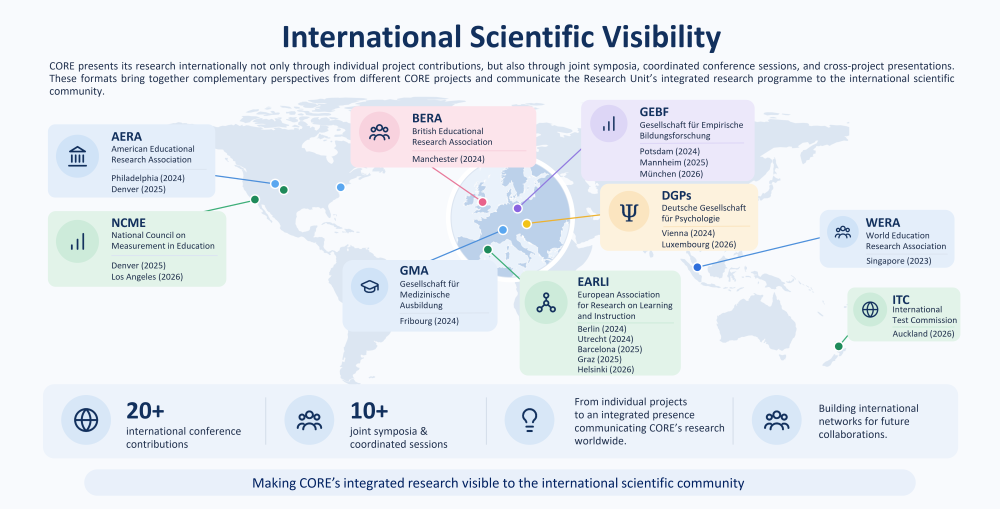
A complete list of our conference contributions is available under Publications – Presentations.